How to Scope a Real Estate ERP in 4 Hours: AI-Assisted Product Roadmap Case Study
How I Used AI to Deconstruct a Complex ERP Requirement — A Case Study in Product Thinking
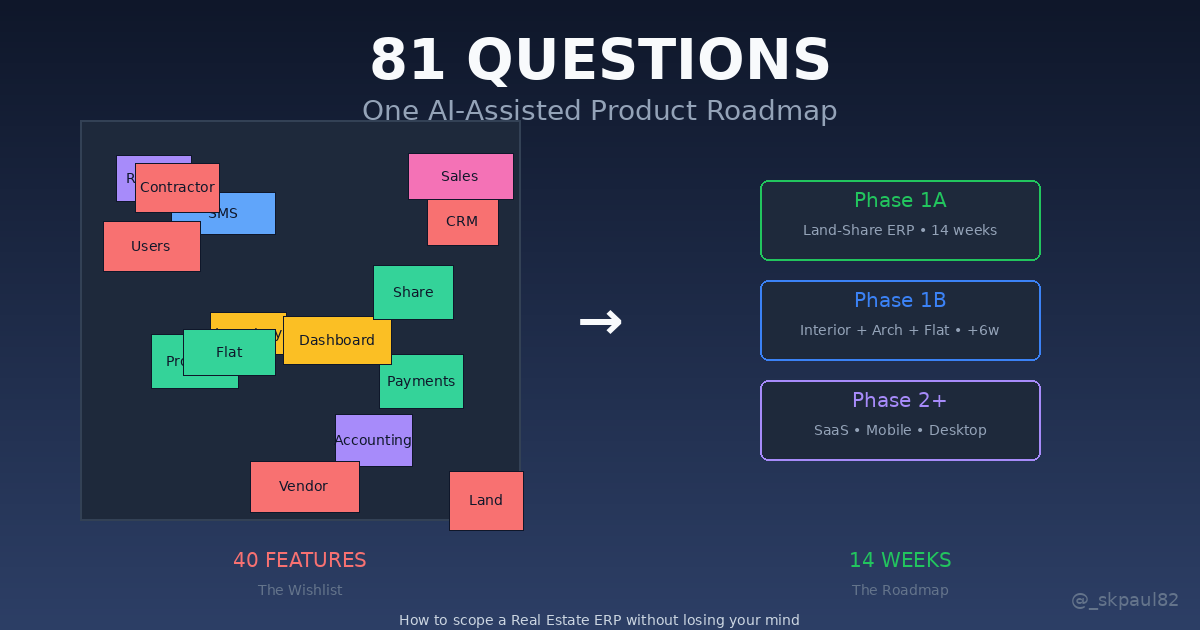
Last weekend, one of my friends (a real estate consultant) asked me to help him think through a software idea. He had a 40-feature wishlist for an ERP system. My job? Not to build it — but to help him figure out what not to build first.

I used an AI-assisted “grilling” method I’ve been refining for product scope management. Here’s what happened, what we learned, and why I think every SaaS founder needs a “no” list before a feature list.
The Starting Point — A Feature List That Scared Me
He sent me a list:
- Dashboard, Project Management, Purchase Model
- Land/Flat/Share Inputs, Inventory, Customer SMS
- Accounting, CRM, Vendor Management
- Payment Scheduler, Income/Expense, Cheque Management
- Contractor Listing, Sales Reports, Location Management
- Employee Listing, User Management, Reporting, Unlimited Users
Plus a full CRM module.
My first thought: This is 3 products pretending to be one.
This is the classic SaaS scope creep trap — building for everyone, serving no one.
The Method — One Question at a Time
I didn’t start sketching architecture. I started asking:
“Is this one system or two?”
“Who’s the first user?”
“What happens if we ship without SMS notifications?”
“Do interior designers even use ‘inventory’ the same way?”
81 questions later, we had clarity.
The hardest question: “What if we only build for land-share deals first?”
His instinct: “But then we’re missing 80% of the market.”
My counter: “But if you build everything, you serve 0% well.”
This is MVP scope discipline in action — saying no to good ideas so great ones can ship.
What We Landed On — A Phased ERP Roadmap
| Phase | Scope | Timeline |
|---|---|---|
| Phase 1A | Land-Share ERP only | 14 weeks |
| Phase 1B | Add Interior, Architecture, Flat | +6 weeks |
| Phase 2 | SaaS multi-tenancy | TBD |
| Phase 3+ | Mobile, payment gateways, desktop | TBD |
33 features deferred. Not cut forever — just cut first.
This is agile product development for resource-constrained teams. Ship a narrow vertical, validate, expand.
The Technical Decisions That Matter
- API-first Laravel backend — because mobile and desktop are inevitable
- Vue SPA for client portal, Blade + Alpine.js for admin — pragmatic, not trendy
- Local disk storage with cloud migration path — cheapest start, no dead end
- Sanctum auth — simple now, OAuth later if enterprise clients demand it
Every choice asked: “What’s the cheapest way to not regret this later?”
This is technical debt management — borrowing strategically, not accidentally.
What I Learned (Again)
1. AI doesn’t replace product judgment. It exposes where you’re winging it.
Every question the AI asked, I had to answer. No hiding behind “we’ll figure it out.”
2. “Standalone first, SaaS later” is underrated.
Building multi-tenancy before you have one tenant is premature optimization — a leading cause of startup death.
3. The best PRD is the one that says no.
Ours has 33 deferred decisions logged. That’s 33 arguments we won’t have in Week 8.
The Full PRD
If you’re building a real estate SaaS, an ERP system, or any multi-feature product or Micro-SaaS. Let me know; I will share the process and skills with you and also share the full 559-line PRD. It’s not a template — it’s a real product decision log with:
- 81 functional requirements
- 33 deferred decisions
- 20-week implementation plan
- Laravel + Vue technical architecture
Use it if you’re wrestling with feature prioritization or MVP scope definition.
FAQs
Q1: What is AI-assisted product scoping?
AI-assisted product scoping uses structured questioning — often one at a time — to surface hidden assumptions, conflicts, and dependencies in a product idea. The AI asks; the human decides. It’s not automation — it’s augmented product thinking.
Q2: How do you prioritize features for an ERP MVP?
Start with the smallest vertical that delivers standalone value. For this project, land-share deals were narrower than flats or interior design — but complex enough to validate the entire payment, accounting, and customer management engine. If that works, expansion is low-risk.
Q3: What tech stack is best for a real estate ERP in 2026?
For a standalone-first, SaaS-ready ERP: Laravel (API backend), Vue.js (interactive portal), Bootstrap + Alpine.js (admin panel), Sanctum (auth), PostgreSQL/MySQL (database). This stack balances speed, cost, and future-proofing.
Q4: How long does it take to build an ERP MVP?
A focused ERP MVP with one vertical (like land-share management) takes 12-16 weeks with a 2-person team. Expanding to multiple verticals adds 4-8 weeks per preset. The killer is not coding — it’s scope clarity.
Q5: What’s the biggest mistake when scoping a SaaS product?
Building for hypothetical users instead of one real user with one real problem. Every feature needs a named customer and a specific workflow. If you can’t name who uses it and when, defer it.
Conclusion
If you’re staring at a feature list that terrifies you, try this: pick the smallest slice that still hurts to cut. That’s probably your MVP.
The rest can wait. The market will tell you when it’s ready.
I’m a senior developer & solopreneur. I write about product thinking, Laravel development, and the gap between “idea” and “shipped.” Connect with me on LinkedIn.
Related Reading: Coming soon..
- How to Scope a SaaS MVP Without Losing Your Mind
- Laravel API-First Architecture: A Practical Guide
- Why Standalone-First Beats SaaS-First for Early Startups